
















Should I pick the product or the imprint method first for a printed giveaway?
 By Promogator Staff
Reviewed Nov 17, 2026 2 min read
Pick the product first. The item decides which imprint methods work: pad printing suits small, curved or hard items like pens, while UV and digital printing suit flat, full-color artwork. Start with who gets it and how they will use it, then check that product's methods against your logo's colors and size.
- Choose the product first; it limits which imprint methods are possible.
- Pad print suits small, curved items; UV and digital suit full-color art.
- Count your logo colors before you commit to a method.
- Each product page lists the methods that item offers.
- Check the proof, since the final print can differ slightly.
Why the product usually comes first
The item sets the rules. A ballpoint pen, a flat notebook cover and a stainless steel bottle each accept different decoration. Many items offer only one or two methods. If you pick a method first, you may find that your favorite item cannot take it.
Think about the person holding the giveaway. Will they use it every day? Will it be handed out at a booth, a school event or a church fair? A useful item gets kept, and a kept item keeps your logo in sight.
How the three methods differ
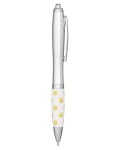
- Pad printing presses ink from an etched plate onto the item with a soft silicone pad. It handles small, curved or uneven surfaces, such as pens, stress balls and small hard goods. It usually works best with simple logos in a few flat colors. Typically up to 4 colors.
- UV printing uses ultraviolet light to cure ink right after it is printed. It can reproduce full-color artwork on many hard, flat surfaces.
- Digital printing prints your artwork directly, with no plate for each color. That makes gradients, photos and many colors easier to reproduce, and it often suits smaller runs.
The imprint methods page shows these side by side. Each product page lists which methods that item offers.
Let your logo narrow the choice
Once you have a product in mind, look at your artwork.
- One or two flat colors: pad print is often a good fit on small items.
- Gradients, photos or many colors: look for UV or digital full-color options.
- Fine detail: very small text and hairline strokes may not reproduce well on any method. Keep text readable at the size of the imprint area.
The imprint area matters too. A small item has a small print space, so a wide logo may need to be simplified or stacked.
Mistakes to avoid
- Falling in love with a method before checking the item can take it.
- Ordering without checking the imprint size against your logo.
- Forgetting that setup charges and per-piece costs vary by method. The product page shows them.
- Skipping the proof. Material and method can make the final print differ slightly from the screen.
A quick example
Say you need 100 giveaways for a community event and your logo has two colors. Choose a pen or a small keepsake, confirm it offers pad print, then compare it with one or two other items. If your logo later gets a full-color redesign, filter for items offering UV or digital print instead.
If you are short on time, check the rush products page, since a firm in-hands date can narrow your options more than the method does.
Products that work for this
Real examples from our catalog, with live pricing. Tap one to see it with your logo.


Shop Pens & Writing
See all →


People also ask
Do I choose the item or the print method first?
Choose the item first. Its material, shape and print area decide which methods are possible. Then match your logo's colors and detail to the methods that item offers.
How should I plan a printed giveaway step by step?
Set your audience, quantity and in-hands date. Pick a useful item, check its imprint methods against your logo, then request a proof and approve it. Allow time for production and shipping.
How do I start picking a printed item for my event?
Start with who will receive it and how they will use it. Shortlist a few items in your price range, then check each product page for imprint methods, minimums and production time.
When does pad printing make sense?
Pad printing makes sense for small, curved or uneven items with a simple logo in a few solid colors. Pens are a common example.
What if my logo has many colors?
Look for items that offer UV or digital full-color printing. These methods handle gradients and many colors better than pad printing, which is limited to a few spot colors.
Ask PromoAI these questions
Tap one and PromoAI searches our live catalog and answers in seconds.

