

















Custom banner or lightweight flag for a one-day event: which should I pick?
 By Promogator Staff
Reviewed Nov 18, 2026 2 min read
For a one-day event, a lightweight flag is usually the fastest to set up and take down, and it catches attention from a distance. A banner is better when you need more text, such as dates or a web address, and you have a fence, wall or frame to hang it on. Choose by space and message.
- Flags set up fastest and need no wall or fence.
- Banners hold more words, so they suit detailed messages.
- Wind and ground type matter more for flags than for banners.
- Keep one clear message and a high-contrast logo on either one.
- Check each product page for sizes, hardware and imprint options.
How the two compare
Both work for a single day. They solve different problems.
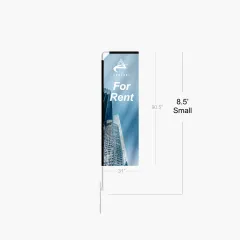
A lightweight flag is a fabric panel on a pole. The pole goes into a base or a ground stake. Because it rises above the crowd, people can spot it from far away. It moves in the breeze, which draws the eye. A flag works best with a logo, a short word or two, and strong color.
A banner is a flat panel, usually vinyl or fabric. You hang it on a fence, wall, table front or frame. It gives you a larger flat area, so it can carry a headline, a date, a web address or a short list. Banners are also easy to read up close.
What to weigh
- Message length. If your message is a logo and three words, choose a flag. If it needs a date, a location or a call to action, choose a banner.
- Setup surface. A banner needs something to attach to. Flags need a base or soft ground for a stake. Check what your venue allows before you buy.
- Setup and teardown. Flags typically go up in a few minutes: assemble the pole, slide on the flag, set the base. Banners are quick too if you have grommets and ties, but you need a place to tie them. A banner stand adds hardware to carry.
- Wind. Outdoor flags need a sturdy base or stake, and you should take them down in strong wind. A banner can also catch wind, so tie it at several points. Mesh banners let some air through.
- Viewing distance. Flags are seen from afar. Banners are read at closer range.
- Indoor or outdoor. Many fairs are outdoors, where flags shine. Indoor halls often limit stands and hanging, so confirm the rules with the organizer.
Simple rules of thumb
- Booth at a fair with open ground: a flag marks your spot, and a small banner on the table front explains what you offer.
- A fence or wall is available: a banner is simple and low cost to hang.
- Many booths look alike: a flag lifts your brand above the row.
- Short message, many people walking by: flag.
- Detailed message, people stopping to read: banner.
You do not have to choose only one. A flag for visibility plus a banner for detail is a common pairing.
Mistakes to avoid
- Putting small text on a flag. It will be hard to read in motion.
- Skipping the venue rules on stakes, weights and hanging.
- Ordering without a plan for the base or ties.
- Using low-resolution art. Send a vector logo when you can.
- Waiting too long. Check the production time on the product page and plan backward from your event date.
For artwork, a free digital proof shows your logo on the product before anything is printed. Check size, colors and placement there.
Products that work for this
Real examples from our catalog, with live pricing. Tap one to see it with your logo.


Shop Flags
See all →People also ask
Is a flag or banner better for a one-day fair?
Use a flag to get noticed from a distance across an open fairground. Use a banner when visitors need details once they arrive. If you pick one, choose the flag for visibility or the banner for information.
What is easiest to set up for a one-day event?
A lightweight flag is typically easiest. You assemble a pole, add the flag and set the base or stake. A banner is also easy if you have a fence or wall with something to tie it to.
Which sign is fast to put up and take down?
Flags and banners with grommets both go up quickly. Flags need no surface to attach to. Banners need ties and a spot to hang. Pack the base, stake or ties with the sign so nothing gets left behind.
Can I use a flag or banner indoors?
Often yes, but check the venue first. Many halls limit stakes, weighted bases or hanging points. Ask the organizer what is allowed. Indoors, a banner on a table or wall usually fits more easily than a tall flag.
Ask PromoAI these questions
Tap one and PromoAI searches our live catalog and answers in seconds.

